Your Descartes rule of signs examples images are available. Descartes rule of signs examples are a topic that is being searched for and liked by netizens now. You can Download the Descartes rule of signs examples files here. Get all free photos.
If you’re looking for descartes rule of signs examples images information connected with to the descartes rule of signs examples keyword, you have visit the right blog. Our site always gives you suggestions for seeking the highest quality video and image content, please kindly surf and locate more informative video content and graphics that fit your interests.
Descartes Rule Of Signs Examples. The polynomial g x x 3 x 2 1 has two sign changes but no positive roots. Descartes rule of signwhat is descartes rule of signsdescartes rule of signs examples. For example the polynomial function eqh x x3 x-1 x3 x5 eq can be rewritten as eqh x x32 x-1 x5 eq which shows that. Descartes Rule Of Signs Example Alqurumresort Com.
 Pin On Math From pinterest.com
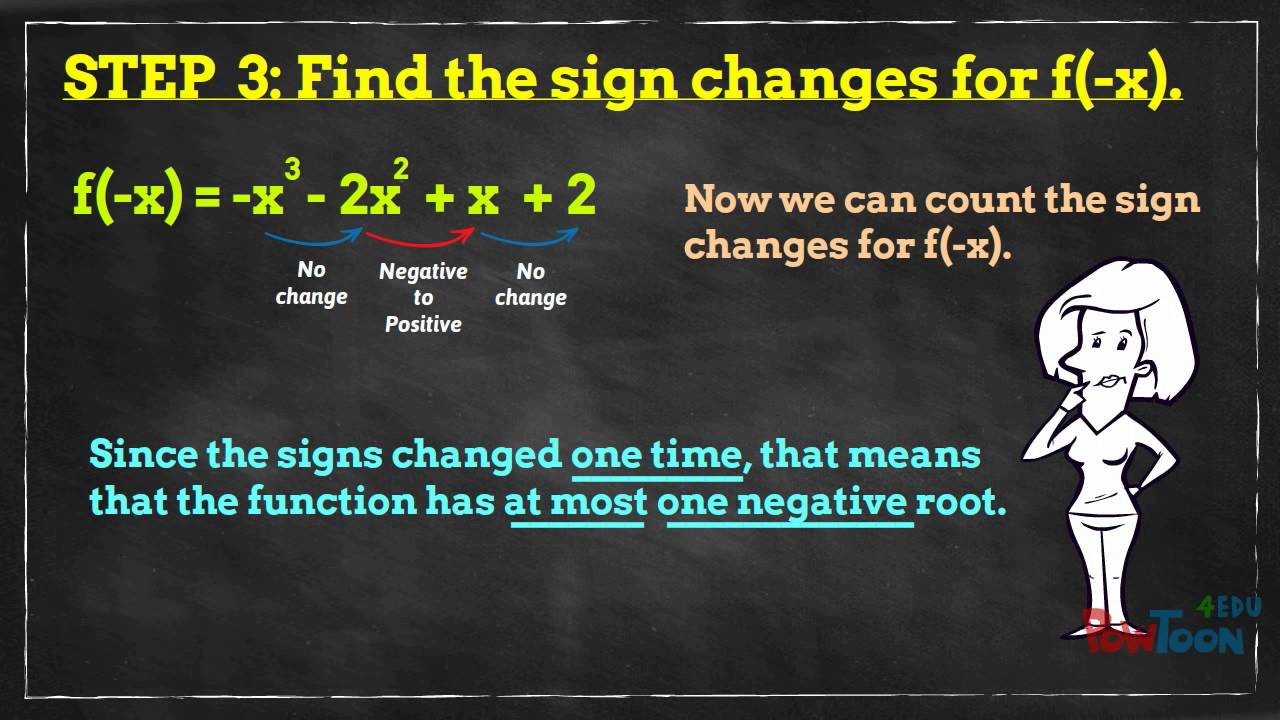
Quick examples for both cases. 1 f x 3x4 20 x2 32 Possible positive real zeros. 2 or 0 Possible negative real zeros. GUIDED PRACTICE for Example 4 Determine the possible numbers of positive real zeros negative real zeros and imaginary zeros for the function. So in the example above the number of negative real roots must be either 1. For instance suppose the Rational Roots Test gives you a long list of potential zeroes youve found one negative zero and the Rule of Signs says that there is at most one negative root.
In fact an easy corollary of Descartes rule is that the number of negative real roots of a polynomial f x is determined by the number of changes of sign in the coefficients of f -x.
The rule gives an upper bound number of positive or negative roots of a polynomial. Descartes rule of signwhat is descartes rule of signsdescartes rule of signs examples. To illustrate the variety of signs of a polynomial fx here are some of the examples on the Descartes Rule of Signs. Quick examples for both cases. Find the number of. Finding the Number of Sign Variations in a Positive Polynomial Function.
 Source: pinterest.com
1 Possible negative real zeros. Its inverse is given by x 7x x1. Example II FigureFunctions g 10 g 25 and g 100 compared with g. 1 2 f x 5x4 42 x2 49 Possible positive real zeros. 1 Possible negative real zeros.
 Source: pinterest.com
We propose function families possessing these properties on the number of. All groups and messages. The number of negative real zeros of the fx is the same as the number of changes in sign of the coefficients. Use Descartes Rule of Signs to determine the of positive and negative real roots fx 2x. Then you know that youve.
 Source: pinterest.com
Descartes Rule of Signs Date_____ Period____ State the possible number of positive and negative zeros for each function. Descartes Rule of Signs can be useful for helping you figure out if you dont have a graphing calculator that can show you where to look for the zeroes of a polynomial. 2 or 0 Possible negative real zeros. 12 Diagnostic Tests 380 Practice Tests Question of the Day Flashcards Learn by Concept. 1 f x 3x4 20 x2 32 Possible positive real zeros.
 Source: pinterest.com
Fleft xright4x4-3x32x2-1x99 f x 4x4 3x3 2x2 1x 99 answer choices 3 or 1 positive roots and 0 negative roots. 1 f x 3x4 20 x2 32 Possible positive real zeros. Example II FigureFunctions g 10 g 25 and g 100 compared with g. The possible numbers of zeros for f are summarized in the table below. The number of negative real zeros of the fx is the same as the number of changes in sign of the coefficients.
 Source: pinterest.com
Quick examples for both cases. For example the polynomial function eqh x x3 x-1 x3 x5 eq can be rewritten as eqh x x32 x-1 x5 eq which shows that. Create An Account Create Tests Flashcards All Precalculus Resources. Descartes rule of signs determines the maximum number of positive and negative real roots of a polynomial. More precisely the number of sign changes minus the number of positive roots is a multiple of two.
 Source: pinterest.com
The polynomial g x x 3 x 2 1 has two sign changes but no positive roots. The possible numbers of zeros for f are summarized in the table below. 1 Possible negative real zeros. Determine the Number of Positive and Negative Real Zeros of a Polynomial Using Descartes Rule of Signs Study concepts example questions explanations for Precalculus. We propose function families possessing these properties on the number of.
 Source: pinterest.com
For example the polynomial function eqh x x3 x-1 x3 x5 eq can be rewritten as eqh x x32 x-1 x5 eq which shows that. Example II FigureFunctions g 10 g 25 and g 100 compared with g. Determine the Number of Positive and Negative Real Zeros of a Polynomial Using Descartes Rule of Signs Study concepts example questions explanations for Precalculus. For example the polynomial f x x 3 3 x 2 3 x 1 has three sign changes but just one positive root of multiplicity 3 at x 1. GUIDED PRACTICE for Example 4 Determine the possible numbers of positive real zeros negative real zeros and imaginary zeros for the function.
 Source: pinterest.com
For instance suppose the Rational Roots Test gives you a long list of potential zeroes youve found one negative zero and the Rule of Signs says that there is at most one negative root. Use Descartes Rule of Signs to determine the possible number of positive and negative roots. For large enough n the number of sign. However it is not a complete criterion and so does not provide the exact number of positive or. In mathematics Descartes rule of signs first described by René Descartes in his work La Géométrie is a technique for determining the number of positive or negative real roots of a polynomial.
 Source: pinterest.com
In mathematics Descartes rule of signs first described by René Descartes in his work La Géométrie is a technique for determining the number of positive or negative real roots of a polynomial. 1 f x 3x4 20 x2 32 Possible positive real zeros. 2 or 0 Possible negative real zeros. Create An Account Create Tests Flashcards All Precalculus Resources. So in the example above the number of negative real roots must be either 1.
 Source: pinterest.com
GUIDED PRACTICE for Example 4 Determine the possible numbers of positive real zeros negative real zeros and imaginary zeros for the function. The rule gives an upper bound number of positive or negative roots of a polynomial. The number of negative real zeros of the fx is the same as the number of changes in sign of the coefficients. Find the number of. Use Descartes Rule of Signs to determine the of positive and negative real roots fx 2x.
Source: pinterest.com
Descartes rule of signs determines the maximum number of positive and negative real roots of a polynomial. The polynomial g x x 3 x 2 1 has two sign changes but no positive roots. Descartes Rule of Signs can be useful for helping you figure out if you dont have a graphing calculator that can show you where to look for the zeroes of a polynomial. It tells us that the number of positive real zeros in a polynomial function fx is the same or less than by an even numbers as the number of changes in the sign of the coefficients. For instance suppose the Rational Roots Test gives you a long list of potential zeroes youve found one negative zero and the Rule of Signs says that there is at most one negative root.
 Source: pinterest.com
1 2 f x 5x4 42 x2 49 Possible positive real zeros. Descartes Rule Of Signs Example Alqurumresort Com. Descartes Rule of Signs states that the number of positive roots of a polynomialpx with real coe cients does not exceed the number of sign changes of the nonzero coe cients of px. Finding the Number of Sign Variations in a Positive Polynomial Function. For example the polynomial function eqh x x3 x-1 x3 x5 eq can be rewritten as eqh x x32 x-1 x5 eq which shows that.
 Source: pinterest.com
Timestamps for Examples -Intro 000Example 1 057Example 2 1026Example 3 1658Example 4 2440Example 5 2750. Use Descartes Rule of Signs to determine the possible number of positive and negative roots. GUIDED PRACTICE for Example 4 Determine the possible numbers of positive real zeros negative real zeros and imaginary zeros for the function. In mathematics Descartes rule of signs first described by René Descartes in his work La Géométrie is a technique for determining the number of positive or negative real roots of a polynomial. For instance suppose the Rational Roots Test gives you a long list of potential zeroes youve found one negative zero and the Rule of Signs says that there is at most one negative root.
 Source: pinterest.com
Descartes Rule Of Signs Example Alqurumresort Com. GUIDED PRACTICE for Example 4 Determine the possible numbers of positive real zeros negative real zeros and imaginary zeros for the function. Create An Account Create Tests Flashcards All Precalculus Resources. However it is not a complete criterion and so does not provide the exact number of positive or. To illustrate the variety of signs of a polynomial fx here are some of the examples on the Descartes Rule of Signs.
 Source: pinterest.com
Determine the Number of Positive and Negative Real Zeros of a Polynomial Using Descartes Rule of Signs Study concepts example questions explanations for Precalculus. Descartes rule of signs determines the maximum number of positive and negative real roots of a polynomial. Use Descartes Rule of Signs to determine the of positive and negative real roots fx 2x. Finding the Number of Sign Variations in a Positive Polynomial Function. 1 2 f x 5x4 42 x2 49 Possible positive real zeros.
 Source: pinterest.com
Fleft xright4x4-3x32x2-1x99 f x 4x4 3x3 2x2 1x 99 answer choices 3 or 1 positive roots and 0 negative roots. The possible numbers of zeros for f are summarized in the table below. Create An Account Create Tests Flashcards All Precalculus Resources. Then you know that youve. Descartes Rule of Signs can be useful for helping you figure out if you dont have a graphing calculator that can show you where to look for the zeroes of a polynomial.
 Source: pinterest.com
Then you know that youve. So in the example above the number of negative real roots must be either 1. Descartes Rule Of Signs Example Alqurumresort Com. It tells us that the number of positive real zeros in a polynomial function fx is the same or less than by an even numbers as the number of changes in the sign of the coefficients. To illustrate the variety of signs of a polynomial fx here are some of the examples on the Descartes Rule of Signs.
 Source: pinterest.com
GUIDED PRACTICE for Example 4 Determine the possible numbers of positive real zeros negative real zeros and imaginary zeros for the function. Find the number of. In fact an easy corollary of Descartes rule is that the number of negative real roots of a polynomial f x is determined by the number of changes of sign in the coefficients of f -x. Mart n Avendano Descartes rule of signs. Let Pleft x right has n7 number of sign changes the possible number of positive real roots will be 7 5 3 or 1 Let Pleft x right has n 6 number of sign changes the possible number of negative real roots will.
This site is an open community for users to share their favorite wallpapers on the internet, all images or pictures in this website are for personal wallpaper use only, it is stricly prohibited to use this wallpaper for commercial purposes, if you are the author and find this image is shared without your permission, please kindly raise a DMCA report to Us.
If you find this site value, please support us by sharing this posts to your favorite social media accounts like Facebook, Instagram and so on or you can also bookmark this blog page with the title descartes rule of signs examples by using Ctrl + D for devices a laptop with a Windows operating system or Command + D for laptops with an Apple operating system. If you use a smartphone, you can also use the drawer menu of the browser you are using. Whether it’s a Windows, Mac, iOS or Android operating system, you will still be able to bookmark this website.


